Lemon Shark Update
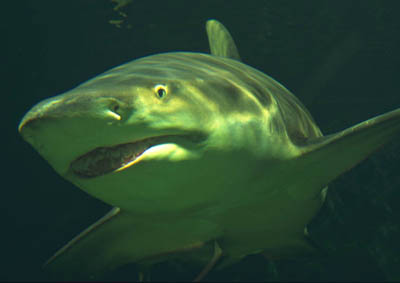
Here is a lemon shark. It looks like it has jaundice
but it is in fact meant to be yellow. Some people think these sharks
are not dangerous but they are wrong. They can do bad biting and
once they have got you they tend not to let you go again. So watch
out.

This lemon shark is swimming along.
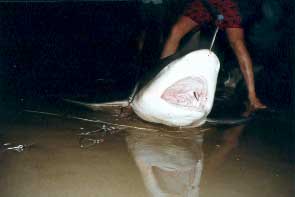
This shark is trying to get the man. Can't blame it
really though; that hook thing looks quite annoying.
Lemon Shark Facts:
Latin Name: Negaprion brevirostris; a requiem
shark.
The triangular teeth are slightly curved. These long,
thin, sharp teeth are designed to catch slippery fish, the mainstay of the
lemon shark's diet.
A young lemon shark loses an entire set of
teeth, one at a time, every 7-8 days. The teeth are located in rows which
rotate into use as needed. The first two rows are used in obtaining prey,
the other rows rotate into place as they are needed. As teeth are lost,
broken, or worn down, they are replaced by new teeth that rotate into
place.
It eats mostly fish (including other sharks), but
will also eats mollusks and crustaceans.
The lemon shark is found in
the Pacific off Latin and South America, in the Atlantic off the coasts of
South America and west Africa, and in the Gulf of Mexico.
Litters
consist of about 36 young which are about 18 inches long at birth.
- Saturday, February 21,
2004
empathy

.jpg)


 some new old things if you see
what i mean. well basically the archive page is new. and on there we have
some nice articles you probably haven't seen:
some new old things if you see
what i mean. well basically the archive page is new. and on there we have
some nice articles you probably haven't seen: